Toilet thoughts
The other day I noticed a set of rules (absolute basic civism) that are hung in the toilet door of my company. This made me think about two different things.
-
The importance of making a good use of uppercase letters. Uppercase letters are there as a resource to emphasize given words, so you definitely should capitalize the words you want the reader to pay more attention to. For me capital letters indicate that you can skip the other words in the sentence and still get a good grasp of what the sentence is about, but then there is some bad usage of capital letters such as the one found in rule number 3 of the following picture
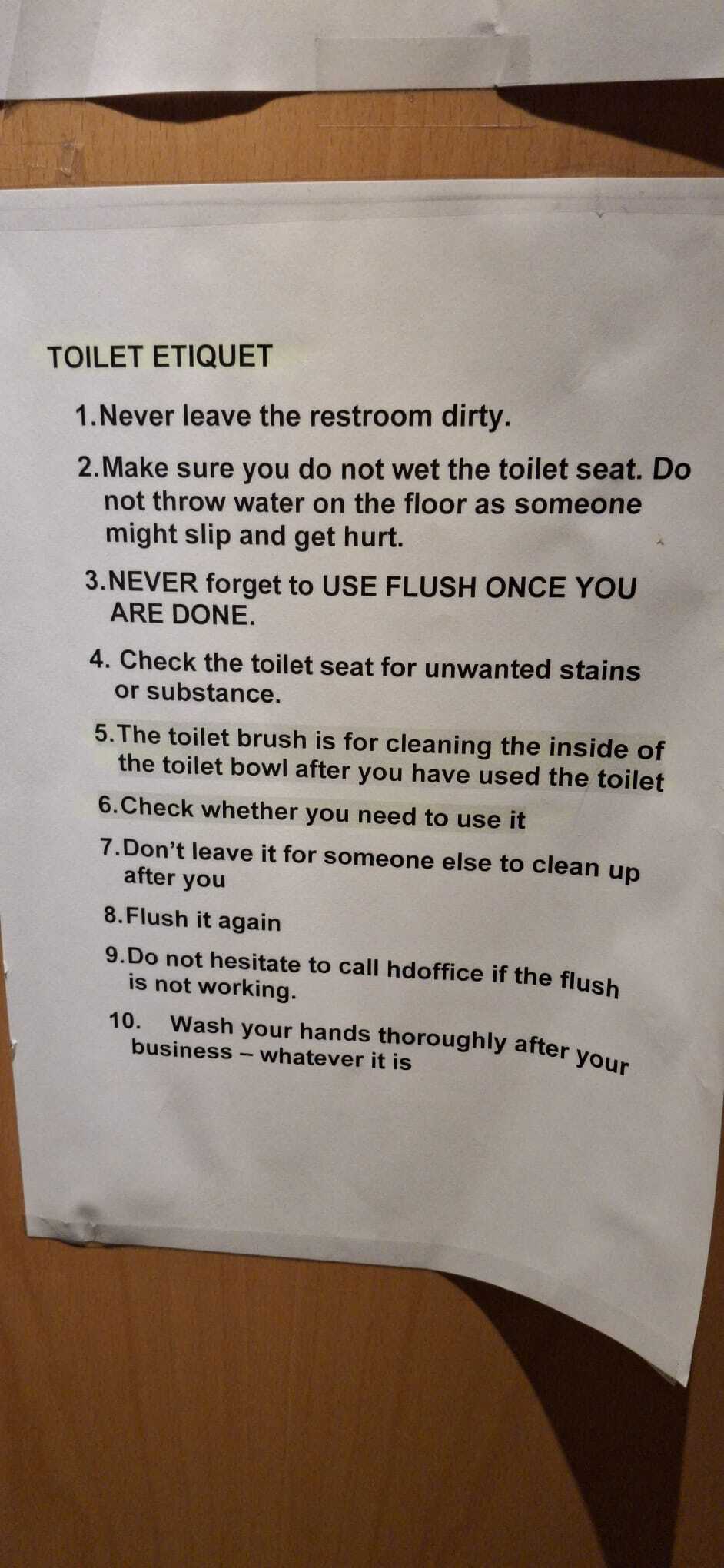
The original purpose of rule number three is quite clear (if not PLEASE go see a therapist), but the choice of uppercases makes it a bit awkward, as just paying attention to the capital words it would read
Never use flush once you are done
And that is not what it’s meant (I hope). A much better choice of highlighting could be
NEVER FORGET to USE FLUSH once you are done
I know that it does not change much, but at least the rule becomes skimmable and the highlighted words are actually the ones. And I believe that it is very important that people write and communicate in a clear and error-free fashion. It is nice to read/ listen to someone who is eloquent and expresses with surgical precision. Also if the person is above eight years old I can’t tolerate spelling mistakes.
-
Which rules make more sense based on culture. There was also this sheet of paper with depictions of actions that were forbidden/ compulsory
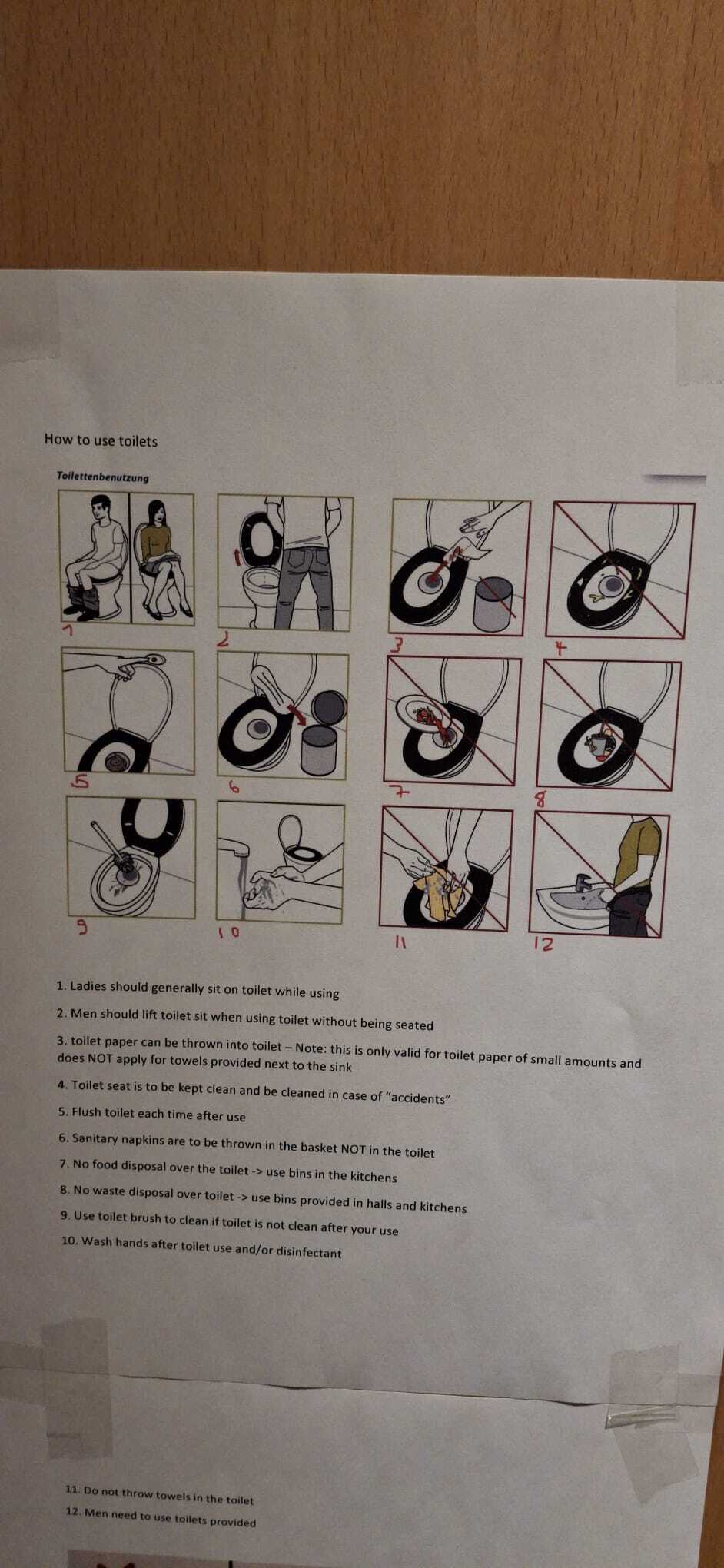
In here I want to focus mainly in rule 11 and 12. These two rules made me think the following: for cultures that are used to toilets rule 11 seems much more bizarre than rule 12, as I feel we would be much more comfortable peeing on a sink than washing our clothes in a toilet. I reckon that this is just because we know what a toilet is, and how is it used, but coming from a culture where you were not used to any bathroom furniture, you would see a nice white ceramic bowl with clean water in it. Described like that it sounds as a good place to clean clothes. Also seeing a big ceramic bowl with no water in it wouldn’t make you want to pee in it, the same way we don’t feel the urge to pee in vases.
So I could see rule 12 being more important than rule 11 for countries with toilets, while rule 11 should be more important than rule 12 for countries without toilets.
This makes me appreciate how the way to interact with the world is mainly driven by our preconceptions and environmental knowledge, and how having a different upbringing or habits can make you do things that would appear outrageous to some other person. This situation could happen in both ways, you being surprised about others’ actions or others being surprised about your own actions.
Because of this I want to be a bit more cautious when taking things from granted or behaving a given way, it could be that under some other framework my actions are deemed as offensive or disrespectful. At the end of the day, it is only a matter of perspective in the eyes of the beholder. Considering this, that our framework might be strange for others, it would be nice if we could share it with unfamiliar people in a polite, kind, understanding and friendly manner.
I find it of no use doing it otherwise if these uncommon behaviours have been unintentional and the result of a lack of knowledge. It is just a reflex of people trying their best at adapting their knowledge of the world into an unknown setting. So the next time you encounter someone washing clothes in the toilet, think how you would behave in an alien society and politely indicate why this is not right, and where it should be done.